
Frequently Asked Questions
Q: Why wind as my source of energy ?
A: There is little doubt that global CO2 emissions have to be greatly
reduced if we are to halt global warming. Wind energy produces more watts
per euro invested than any other type of renewable energy. Admittedly if
there is no wind you will not be generating...BUT...when there is wind
(above 3.2 m per second) you will be generating 24/7, day or night. Emissions are virtually nil.
Q: What power can expect, and what can I use it
for ?
A: In reality, a 1KW wind turbine will only give you 1KW of power if the
wind is blowing at a constant 12.5m/s speed. In practice you should expect
to get 20% of this on a good site, with good average wind conditions. This
will represent anything from 0 to 4KW of power per day. To most
people this figure means nothing much, and so, to put this in laymen's
terms, if you produce 3KW of power over a 24 hour period, this is the
equivalent of boiling your kettle for a full hour constantly in any one
day. Similarly, if you produce 1KW of power, you could operate your
toaster for 1 hour constantly over a single day. This demonstrates
how much power you can expect to receive from your turbine. You can
use this power to store into batteries, for use with an inverter for
powering outbuildings or a remote office, or just to power the lighting in
your house. Alternatively, you can connect the turbine to a
grid-tied inverter and share the turbine power with the "mains" power in
your house/office. This will simply reduce your bills by varying amounts
each day depending on the wind conditions, and you should notice a drop in
your monthly electricity bills of a few percent to 30% at most, depending
on how windy your site really is.
Q: Do I need planning permission ?
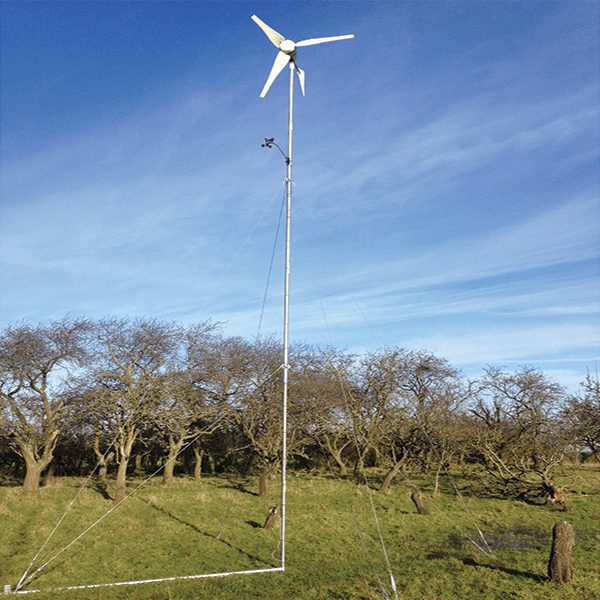
A: If your turbine tower is classed as a temporary structure, we believe, provided the tower is less than
6 metres in height, will probably not need specific planning approval. There is very little precedent but before you install you should check with your Local Authority planning department.
Q: What power can I expect to generate at different wind speeds ?
A: pdf downloads are available in the Products section of this site in graph and numerical formats.
Q: What noise can I expect to hear from the turbine at different wind speeds ?
A: The noise figures shown on our Products Page will mean very little to
most people. Your Planning Department may be more interested in
these figures than anyone else. In reality, the sound that the turbine
makes is 'drowned out' by the noise of the wind, in speeds over
7m/s.
The best way to describe the sound of the turbine is that it sounds
similar to the noise that the wind makes when blowing through trees.
In reality, on a windy day, your ears will be able to distinguish the
unique sound of the turbine from the noise of the wind, but it will
sound no loader.
Q: Can I connect several turbines in parallel to one large
battery bank to get much higher powers ?
A: Yes, as long as you use one Charge Controller and Dump Load for each
turbine you connect together. You should also ensure that your battery
bank capacity is greater than 200Ah per turbine, so if you intend to
connect 5 of our FE1024 turbines to one 24V battery bank, you will require
5 Charge Controllers, 5 Dump Loads and a battery bank with a capacity of
at least 1000Ah @ 24V. The cabling which connects all your charge
controllers to the battery bank should be the same length in order to
properly share the power that's being dumped. We suggest that a maximum of
6 wind turbines are connected in this manner, since the wiring and
complexity of larger turbine numbers will be unreasonable.
Q: Can I convert 24 and 48 volt DC to 240 volts AC ?
A: Our Turbines all generate DC electricity at 12, 24, 36 or 48 volts (see specifications) You can convert this to 240 volts AC to power lighting circuits, and very light domestic appliances by using a DC to AC Inverter. These are fairly inexpensive, compact, portable and readily available. Please contact us for more information
Q: Would your Permanent Magnet Generators be suitable for a bicycle power generator? At a cadence of 100 and a gearing ratio of 52:11 I can generate about 473 RPMs but I think I can only sustain about 200 watts for a reasonable period of time. I'm looking to put in a solar and wind power plant with an additional bicycle charger, to run lighting and small appliances. This type of generator seems ideally suited but I'm wondering if you have a smaller version?
A: In reply to the question, the answer is yes. The potential
buyer hasn't indicated what voltage of batteries he intends to use the
generators to charge. If it's 24V then he would only require a 52:20 ratio
to get the 200W output or so he desires. It would be easy to change the
ratio to suit the desired output power requirements. It's not practical to
expect to use a 'person' powered generator to produce any more than
100W
or so. Even a pro' cyclist could only produce 400W peak power for a short
burst, so he is being practical in his calculations. Any of the 4 PMG's would be an ideal generator for this type of application, as it has a large 'flywheel' effect when in use, which would feel smoother than a smaller generator, which may be very difficult to obtain.
Q: Have your generators ever been used with the Savonius or Darrieus models of ( vertical axis) wind turbine?
A: The two types of vertical turbine you mention are normally used for smaller applications.
Q: We were asked a few days ago if our PMG would work with a Forgen (vertical axis) turbine.
A: We will be addressing this in the near future and will almost certainly develop a smaller PMG which should lend itself better to this sort of application.
Q: I want to charge 12/24v batteries or dump the voltage. You say its just a case of adjusting the RPM, but isn't RPM just the force of the wind ?
A: In the case of using the generators to build a wind turbine, then the RPM is related to the wind, that is correct. These PMG's can in fact be used for all kinds of generator builds though, such as petrol/diesel or water powered systems, where the RPM can be altered accurately. If the user wants to use the generators to make their own wind turbines, then the power curves for each generator can be downloaded from the
Products Page from which the user can select the correct generator for their intended wind turbine blades etc.
Q: I would buy this if I could source engineering components, eg. bearings, pulleys, belts, etc. to build my complete generator, can you recommend a catalogue supplier?
A: We buy from many Industrial Supply Catalogues and it's hard to understand why but simple pulley wheels are really expensive (about £20.00 each). You can pick up all sort of pulleys (and belts) from motor scrap dealers, new belts from car part suppliers and bearings from companies like Seager Bearings who have depots uk-wide.
Q: Do your PMG's need a gearbox?
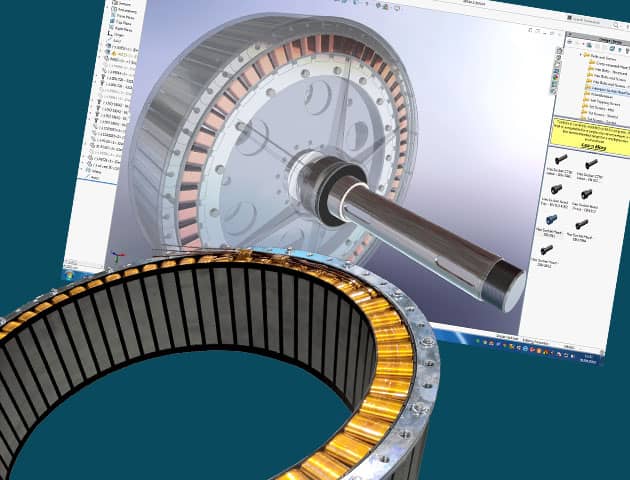
A: These PMG's don't require a gearbox since they have been designed to produce a high power output at very low RPM's. The rectifier is used to convert the 3-Phase AC output from the generators into DC, for battery charging or any other application you feel would suit the output.
Q: What is the winding configuration of this generator?
A: The generators are all Delta wound.
Q: The PMG we received seems to take a lot of effort to rotate the unit when turning by hand?
A: If there's nothing connected to the output wires, and they're not shorted together, then the motor should be able to be turned by hand. It will 'cog' between poles as you rotate it. If you connect a 10W or 20W halogen bulb between any 2 of the 3 output wires and grip the axle in a vice, it should be possible to rotate the generator by hand to light the bulb. The generators have 16 poles and powerful magnets which do take a bit of a shove to move from pole to pole when just holding in the hand. This is perfectly normal and in fact when you have blades or a water wheel attached the extra leverage spins it really easily. If you cannot rotate the generator by hand at all, or it requires a lot of effort to even rotate it through only a few degrees, check that the output wires are not touching together, thus shorting out the output, thus acting as a massive electrical brake. If you have a digital multimeter, set it to measure 0 to 10 Ohms and measure the resistance between all pairs of output connections, ie. between any 2 of the 3 connections, then between the odd connection and each of the other 2. The reading should be between 1 and 2 ohms. If your meter reads a short circuit, then there may be an internal short between the wires inside the generator, and it should be returned for replacement.
Q: What is the IP rating of the generator? Will it need extra weather proofing? Can I charge 12v batteries and how do I drop the voltage. Is this covered in the circuit diagram?
A: The generators have no IP rating at present, and as such, you may want to add a protective spray coating on the outer face of the generator from time to time to limit the chances of degradation from a cosmetic point of view. They are suitable for continued use outdoors, but their outer paint finish will degrade through years of harsh exposure. To charge 12V batteries, simply connect the output of the 3-phase bridge rectifier to the batteries. As the RPM increases above around 200 rpm, the batteries will begin charging, further increases in the rpm will increase the charge current up to a maximum of 25 to 30A. Use a charge controller to limit the voltage of the batteries, to avoid overcharging.
Q: Do you think that a site 80 feet from the nearest neighbour will be ok for noise?
A: 80 feet should be fine. The only noise is that produced by the blades which is more of a whirring than anything else, louder in very high winds, but then the wind is noisy through trees anyway.
Q: I was hoping to use whatever energy I generate to heat water. Could you advise on the best way to proceed?
A: Beewind sell a 300 watt water heater which farmers seem to use, mainly for stopping troughs freezing in winter. They have a 1'' thread and can be screwed into your domestic immersion heater draincock hole.
Q: Does it matter which way the PMG spins?
A: All our PMG's operate identically in both directions.
Q. Our intention is to use a wind powered generator output to supplement the heating of an existing circulated hot water heating system. The site is an open rural location. We would like to avoid having to have banks of lead acid batteries and would like to feed the heater element directly with the output from the wind generator. From our researches we know that there are heater elements and associated pipework that can be incorporated into existing circulated hot water circuits and this is what we would like to power from the wind generator. The problem will be locating a low voltage heating element. The 3 phase output of the generator will probably necessitate doing a DC conversion and feeding this to the heater element.|
A. If your intention is to make the in-line heating tank with
associate paperwork, then you could use 12V 300W elements and
connect them in series to give 36V or 48V worth of heaters. These
heaters cannot however be driven directly form the turbine, which will
impose a load of around 1200W at 48V, when using 4 x 300W 12V heaters.
The heavy load that these elements present to the turbine will prevent
it from starting up, and as such you will require to use batteries and a
"Load Controller" to connect the power from the turbine to your heaters.
Q.Can you recommend a 3 phase rectifier and if you have its cost. Also the only inverters I can find are rated up to 600w do you know of any of higher power and not too expensive. What are your thoughts on direct connection to a conventional 240v heating appliance, e.g. some form of immersion water heater or do you know of any low voltage equivalents?
A. The 3 phase rectifier kit we use consists of 3 single phase rectifiers. This is the lowest cost way of rectifying 3 phase to our knowledge. The kits are £16.20 each. There are inverters rated up to 8kW available. There are low voltage immersion heater elements available which are designed to operate on 12V or 48V. These fit into the drain plug of a standard heating tank. You could connect the turbine to an immersion heater element, but a 3kW element will only produce around 130W, so would not act as a suitable load. A 9kW shower element will give you about 400W at 48V and this is slightly better than using an immersion heater. |